Table of Contents
1. Introduction & Overview
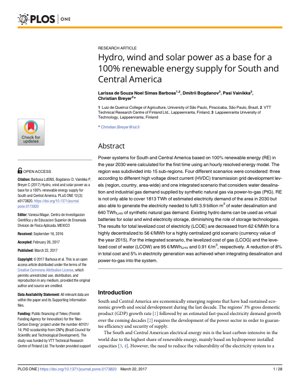
This research presents a pioneering, hourly-resolved energy system modeling study for achieving a 100% renewable energy (RE) supply across South and Central America by 2030. The region, while currently boasting the world's least carbon-intensive electricity mix due to high hydropower penetration, faces significant challenges from climate variability threatening water resources. The study investigates the technical and economic feasibility of transitioning to a system dominated by hydro, wind, and solar photovoltaic (PV) power, supported by enabling technologies like high-voltage direct current (HVDC) transmission and power-to-gas (PtG).
2. Methodology & Scenarios
2.1. Energy Model and Regional Subdivision
The analysis utilizes a linear optimization model to minimize total annualized system cost. The geographical area is subdivided into 15 interconnected sub-regions, allowing for the simulation of energy exchange. The model is based on hourly resolution for one reference year, capturing the variability of renewable sources.
2.2. Defined Scenarios
Four primary scenarios were developed to assess the impact of infrastructure and sector coupling:
- Scenario 1 (Region): Limited HVDC grid, mainly within large sub-regions.
- Scenario 2 (Country): Enhanced HVDC connections within countries.
- Scenario 3 (Area-wide): Full HVDC grid integration across all 15 sub-regions.
- Scenario 4 (Integrated): Builds on Scenario 3, adding electricity demand for seawater desalination (3.9 billion m³) and synthetic natural gas (SNG) production via PtG (640 TWhLHV).
2.3. Integration of Water Desalination and Power-to-Gas
The integrated scenario is a key innovation, moving beyond pure electricity supply. It addresses water scarcity through desalination and provides a carbon-neutral fuel (SNG) for hard-to-electrify industrial processes, utilizing excess renewable electricity that would otherwise be curtailed.
3. Key Results & Findings
Key System Statistics (2030, Integrated Scenario)
- Total Electricity Demand: 1813 TWh
- Additional for PtG/Desalination: ~640 TWh for SNG
- Levelized Cost of Electricity (LCOE): 56 €/MWh (centralized grid)
- Levelized Cost of Gas (LCOG): 95 €/MWhLHV
- Levelized Cost of Water (LCOW): 0.91 €/m³
- Cost Reduction from Integration: 8% in total system cost
- Generation Reduction from Integration: 5% due to optimized use of excess energy
3.1. Energy Mix and Capacity
The optimal mix is dominated by solar PV (~50-60% of generation), followed by wind power (~20-30%), and hydropower (~10-20%). The existing hydropower capacity plays a crucial role not just in generation, but more importantly, in providing flexibility.
3.2. Cost Analysis: LCOE, LCOG, LCOW
Grid centralization reduces costs. LCOE drops from 62 €/MWh in the decentralized (Region) scenario to 56 €/MWh in the fully centralized (Area-wide) scenario. The integrated scenario produces SNG and desalinated water at the stated costs, demonstrating the economic potential of sector coupling.
3.3. The Role of Hydropower as Virtual Storage
A critical finding is the use of existing hydro dams as "virtual batteries." By strategically dispatching hydropower in conjunction with solar and wind output, the need for additional electrochemical storage is drastically reduced. This leverages sunk infrastructure costs for massive grid stability benefits.
3.4. Benefits of System Integration
Integrating desalination and PtG creates a 5% reduction in required electricity generation and an 8% reduction in total system cost. This is achieved by utilizing otherwise curtailed renewable energy, improving overall system utilization and economics.
4. Technical Details & Mathematical Formulation
The core of the model is a cost minimization problem. The objective function minimizes total annual cost $C_{total}$:
$C_{total} = \sum_{t, r} (C_{cap} \cdot Cap_{r, tech} + C_{op} \cdot Gen_{t, r, tech} + C_{trans} \cdot Trans_{t, r1, r2})$
Subject to constraints for:
- Energy Balance: $\sum_{tech} Gen_{t,r,tech} + \sum_{r2} Trans_{t, r2, r} = Demand_{t,r} + \sum_{r2} Trans_{t, r, r2} + Storage_{out, t, r} - Storage_{in, t, r}$ for all hours $t$, regions $r$.
- Capacity Limits: $Gen_{t,r,tech} \leq CF_{t,r,tech} \cdot Cap_{r, tech}$ where $CF$ is the hourly capacity factor.
- Storage Dynamics: $E_{t+1, r} = E_{t, r} + \eta_{in} \cdot Storage_{in, t, r} - \frac{1}{\eta_{out}} \cdot Storage_{out, t, r}$
- Hydro Reservoir Management: Constraints modeling water inflow, storage limits, and minimum environmental flows.
The PtG process is modeled with an efficiency $\eta_{PtG}$ (e.g., ~58% for SNG), linking electricity input $E_{in}$ to gas output $G_{out}$: $G_{out} = \eta_{PtG} \cdot E_{in}$.
5. Experimental Results & Chart Descriptions
Chart 1: Installed Capacity by Scenario
A stacked bar chart would show the GW of capacity for solar PV, wind, hydro, and gas turbines (for backup in some scenarios) across the four scenarios. The "Integrated" scenario shows the highest total capacity due to added demand from PtG.
Chart 2: Hourly Generation Profile for a Representative Sub-region (e.g., Brazil Southeast)
A multi-line chart over one week would show hydropower generation smoothing the large diurnal peaks from solar PV and the more variable output from wind. The "virtual battery" effect is visually clear as hydro generation dips during sunny/windy periods and ramps up at night or during calm periods.
Chart 3: System Cost Breakdown
A pie chart for the Integrated Scenario shows the share of total annualized cost attributed to: Solar PV CAPEX & OPEX, Wind CAPEX & OPEX, HVDC Grid, Power-to-Gas Plants, and Desalination Plants. This highlights the capital-intensive nature of the transition.
6. Analytical Framework: Scenario Modeling Example
Case: Evaluating Grid Expansion vs. Local Storage
A utility in Chile (high solar) considers whether to invest in a new HVDC line to Argentina (complementary wind/hydro) or build a large-scale battery farm.
Framework Application:
1. Define Nodes: Chile (Node A), Argentina (Node B).
2. Input Data: Hourly solar CF for A, hourly wind/hydro CF for B, demand profiles, capital costs for HVDC line ($/MW-km) and batteries ($/kWh).
3. Run Model Variants:
- Variant 1 (Isolated): Node A must meet its demand locally, requiring significant battery capacity to cover nights.
- Variant 2 (Connected): Nodes A and B are connected with an HVDC line of defined capacity. Excess solar from A can be sent to B during the day; at night, hydro/wind from B can supply A.
4. Optimize & Compare: The model minimizes the total cost of both variants. The result typically shows that even with transmission costs, Variant 2 is cheaper due to reduced need for expensive storage in A and better utilization of existing flexible hydro in B. This mirrors the study's core finding on the value of transmission.
7. Critical Analysis & Expert Interpretation
Core Insight: This study isn't just a green fantasy; it's a hard-nosed engineering blueprint that reveals the latent financial and strategic value trapped in South America's existing hydro infrastructure. The real breakthrough is reframing hydro dams not as mere generators, but as continental-scale, zero-marginal-cost grid stabilizers—a "virtual battery" that could save hundreds of billions in new storage investments. This turns a potential climate vulnerability (hydrological change) into a cornerstone of resilience.
Logical Flow: The argument is compellingly linear: 1) Variable renewables (solar/wind) are now the cheapest sources. 2) Their intermittency is the main problem. 3) South America has a unique, pre-paid solution—its vast hydro fleet—which can be digitally re-optimized for storage-first operation. 4) Adding HVDC "strings" between complementary regions (e.g., windy Patagonia to sunny Northeast Brazil) creates a geographic battery effect, further reducing costs. 5) Finally, using surplus renewable electrons to make molecules (gas) and water tackles adjacent multi-billion-dollar industrial and scarcity problems, creating a virtuous economic cycle.
Strengths & Flaws:
Strengths: The hourly modeling is state-of-the-art and non-negotiable for credible RE studies. The sector-coupling (PtG, desalination) moves beyond academic exercise to real-world policy relevance. Leveraging existing hydro is a masterstroke of pragmatic thinking.
Flaws: The model's elegance glosses over brutal political and regulatory hurdles. Building continent-spanning HVDC grids involves sovereignty nightmares akin to the EU's struggles. The 2030 timeline is wildly optimistic for project finance and permitting scales of this magnitude. It also assumes social license for new mega-infrastructure, which is increasingly contested. The cost estimates, while referenced to 2015, need urgent updating post-2022 inflation and supply chain shocks.
Actionable Insights:
1. For Regulators: Immediately reform electricity market designs to financially reward flexibility and capacity (not just energy). Hydro operators should be paid for "balancing services" akin to batteries.
2. For Investors: The biggest near-term opportunity isn't in new solar farms—it's in the digitalization and control systems for existing hydropower to maximize their grid-balancing revenue.
3. For Governments: Start with bilateral "energy bridge" treaties (e.g., Chile-Argentina) as pilot projects. Focus R&D on lowering PtG electrolyzer CAPEX, as this is the linchpin for the integrated scenario.
4. Critical Path: The single most important success factor is transmission. Without it, the virtual battery remains fragmented. A Pan-American Grid Initiative, modeled on Europe's TEN-E, must be a top diplomatic priority.
8. Future Applications & Research Directions
- Green Hydrogen Exports: The model's PtG component can be extended to model large-scale green hydrogen production for export to Europe and Asia, transforming South America into a renewable energy powerhouse.
- Climate Resilience Modeling: Future work must integrate more granular climate models to stress-test the system against projected changes in hydrological cycles and wind patterns.
- Distributed Energy Resources (DERs) Integration: Incorporating rooftop solar, behind-the-meter storage, and electric vehicle charging into the model to understand their impact on centralized grid planning.
- Advanced Storage Valuation: Detailed analysis of the economic value provided by hydropower's flexibility, creating standardized metrics to attract investment for modernization.
- Policy & Market Simulation: Coupling the techno-economic model with agent-based models to simulate regulatory frameworks, investment behavior, and cross-border electricity trading agreements.
9. References
- World Bank. (2016). World Development Indicators. GDP growth (annual %).
- International Energy Agency (IEA). (2014). World Energy Outlook 2014.
- International Energy Agency (IEA). (2015). Key World Energy Statistics 2015.
- U.S. Energy Information Administration (EIA). (2015). International Energy Statistics.
- de Jong, P., et al. (2015). Hydropower, climate change and uncertainty in Brazil. Renewable and Sustainable Energy Reviews.
- ONS (Brazilian National Grid Operator). (2015). Weekly Operation Reports.
- EPE (Brazilian Energy Research Office). (2015). Brazilian Energy Balance 2015.
- Bogdanov, D., & Breyer, C. (2016). North-East Asian Super Grid for 100% renewable energy supply: Optimal mix of energy technologies for electricity, gas and heat supply options. Energy Conversion and Management. (For methodology context).
- International Renewable Energy Agency (IRENA). (2020). Global Renewables Outlook: Energy transformation 2050. (For updated cost and potential data).
- Jacobson, M.Z., et al. (2015). 100% clean and renewable wind, water, and sunlight (WWS) all-sector energy roadmaps for 139 countries of the world. Joule. (For comparative 100% RE study methodology).