Table of Contents
1. Introduction & Overview
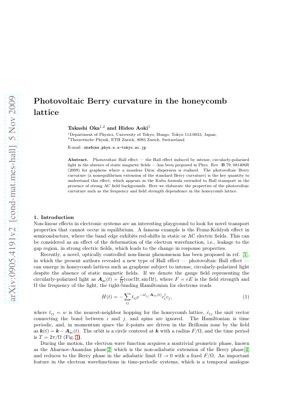
This work explores a novel nonlinear transport phenomenon in two-dimensional materials with honeycomb lattices, such as graphene. The central finding is the photovoltaic Hall effect—a Hall current induced solely by intense, circularly polarized light in the absence of any static magnetic field. This effect is fundamentally different from conventional Hall effects and arises from the manipulation of the electronic wavefunction's geometric phase (Berry phase) in a strong, time-periodic field. The key theoretical object introduced is the photovoltaic Berry curvature, a non-equilibrium generalization of the standard Berry curvature, which governs the Hall response under strong AC driving.
2. Theoretical Framework
2.1 Time-Periodic Hamiltonian & Floquet Theory
The system is described by a tight-binding Hamiltonian on a honeycomb lattice under a circularly polarized AC electric field, represented by a time-dependent vector potential $\mathbf{A}_{ac}(t) = (F/\Omega)(\cos\Omega t, \sin\Omega t)$, where $F = eE$ is the field strength and $\Omega$ the frequency. The Hamiltonian becomes time-periodic: $H(t) = -\sum_{ij} t_{ij} e^{-i\hat{e}_{ij}\cdot\mathbf{A}_{ac}(t)} c^\dagger_i c_j$. According to Floquet theory, solutions to the time-dependent Schrödinger equation can be written as $|\Psi_\alpha(t)\rangle = e^{-i\varepsilon_\alpha t} |\Phi_\alpha(t)\rangle$, where $\varepsilon_\alpha$ is the Floquet quasi-energy and $|\Phi_\alpha(t)\rangle$ is a time-periodic Floquet state. The index $\alpha$ combines the original band index and the photon number $m$ (e.g., $\alpha = (i, m)$).
2.2 Photovoltaic Berry Curvature
The photovoltaic Berry curvature is the central geometric quantity. It emerges from the Aharonov-Anandan phase (a non-adiabatic geometric phase) acquired by the electron wavefunction as the crystal momentum $\mathbf{k}$ is driven in a circular orbit around the Brillouin zone by the AC field: $\mathbf{k}(t) = \mathbf{k} - \mathbf{A}_{ac}(t)$. In the adiabatic limit ($\Omega \to 0$), this reduces to the standard Berry curvature. In the non-equilibrium Floquet picture, it is defined for each Floquet band and dictates the anomalous velocity contribution to the Hall current.
2.3 Extended Kubo Formula
The Hall conductivity in the presence of a strong AC background is derived from a perturbation theory in a weak DC probe field. This leads to an extension of the Kubo formula:
$$\sigma_{ab}(\mathbf{A}_{ac}) = i \int \frac{d\mathbf{k}}{(2\pi)^d} \sum_{\alpha \neq \beta} \frac{[f_\beta(\mathbf{k}) - f_\alpha(\mathbf{k})]}{\varepsilon_\beta(\mathbf{k}) - \varepsilon_\alpha(\mathbf{k})} \frac{\langle\langle \Phi_\alpha(\mathbf{k}) | J_b | \Phi_\beta(\mathbf{k}) \rangle\rangle \langle\langle \Phi_\beta(\mathbf{k}) | J_a | \Phi_\alpha(\mathbf{k}) \rangle\rangle}{\varepsilon_\beta(\mathbf{k}) - \varepsilon_\alpha(\mathbf{k}) + i\eta},$$
where $\langle\langle ... \rangle\rangle$ denotes time-averaging over one period of the AC field, $f_\alpha$ is the non-equilibrium distribution function for the Floquet state $\alpha$, and $\mathbf{J}$ is the current operator. This formula reduces to the standard Kubo formula when $\mathbf{A}_{ac}=0$.
3. Key Results & Analysis
3.1 Frequency and Field Strength Dependence
The photovoltaic Berry curvature, and consequently the Hall conductivity, exhibits a strong dependence on the ratio $F/\Omega$ (field strength to frequency). This parameter controls the radius of the circular orbit of $\mathbf{k}(t)$ in the Brillouin zone. The effect is most pronounced when this orbit probes regions of the band structure with strong intrinsic Berry curvature, such as near the Dirac points in graphene.
3.2 Hall Conductivity Expression
A key simplified result is the expression for the photovoltaic Hall conductivity:
$$\sigma_{xy}(\mathbf{A}_{ac}) = e^2 \int \frac{d\mathbf{k}}{(2\pi)^d} \sum_\alpha f_\alpha(\mathbf{k}) [\nabla_\mathbf{k} \times \mathcal{A}_\alpha(\mathbf{k})]_z,$$
where $\mathcal{A}_\alpha(\mathbf{k}) = i \langle\langle \Phi_\alpha(\mathbf{k}) | \nabla_\mathbf{k} | \Phi_\alpha(\mathbf{k}) \rangle\rangle$ is the Berry connection for the Floquet band $\alpha$. This directly parallels the quantum Hall conductivity formula but with equilibrium eigenstates replaced by non-equilibrium Floquet states and the integration weighted by a non-thermal distribution $f_\alpha(\mathbf{k})$.
4. Core Insight & Analyst's Perspective
Core Insight: Oka and Aoki's work is a masterclass in applying abstract geometry (Berry phase) to predict a tangible, technologically relevant phenomenon—light-induced Hall effect without magnets. The core insight is that intense light doesn't just excite electrons; it can reconfigure the topological landscape of a material's electronic bands in momentum space, creating an effective magnetic field from pure photon angular momentum.
Logical Flow: The argument is elegantly recursive. 1) Circularly polarized light imposes a time-periodic potential. 2) Floquet theory maps this to a set of static "dressed" bands with modified topology. 3) The geometry of these dressed bands is encoded in a non-equilibrium Berry curvature. 4) This curvature acts as an effective magnetic field in momentum space, deflecting carriers to generate a Hall voltage. The logic is airtight, bridging time-dependent perturbation theory, topological band theory, and transport phenomenology.
Strengths & Flaws: The paper's strength is its foundational clarity and predictive power. It provided the theoretical blueprint for what later became the field of Floquet engineering. However, its primary flaw, acknowledged implicitly, is the reliance on an assumed non-equilibrium distribution function $f_\alpha(\mathbf{k})$. The magnitude of the effect is highly sensitive to how electrons populate these photo-dressed bands, a problem that couples Boltzmann transport, electron-electron interactions, and phonon scattering—a complex many-body problem still being untangled today, as seen in later works on heating and thermalization in Floquet systems (e.g., Nature Physics reviews on Floquet matter). The initial proposal likely overestimated the achievable Hall conductivity in realistic, dissipative samples.
Actionable Insights: For experimentalists, the takeaway is to focus on materials with high mobility and weak electron-phonon coupling (like high-quality graphene or Moiré heterostructures) to minimize heating. Use mid-infrared or THz pulses to maximize the $F/\Omega$ ratio without causing damage. For theorists, the next step is integrating this formalism with open quantum system approaches (Lindblad master equations) to realistically model dissipation. For technologists, this effect is a candidate mechanism for ultra-fast, optically controlled non-reciprocal devices (optical diodes, circulators) for photonic integrated circuits, a direction actively pursued by groups at MIT and Stanford.
5. Technical Details & Mathematical Formalism
The mathematical core lies in the treatment of the time-periodic Hamiltonian. The Floquet states satisfy $[H(t) - i\partial_t] |\Phi_\alpha(t)\rangle = \varepsilon_\alpha |\Phi_\alpha(t)\rangle$. Expanding in a Fourier series $|\Phi_\alpha(t)\rangle = \sum_m e^{-im\Omega t} |\phi_\alpha^m\rangle$ leads to an infinite-dimensional time-independent eigenvalue problem in the composite (photon-dressed) Hilbert space:
$$\sum_{m'} \mathcal{H}_{m-m'} |\phi_\alpha^{m'}\rangle = (\varepsilon_\alpha + m\Omega) |\phi_\alpha^m\rangle,$$
where $\mathcal{H}_n = \frac{1}{T} \int_0^T dt\, H(t) e^{in\Omega t}$. The photovoltaic Berry connection is then computed from the $m=0$ component (the "zero-photon" sector) of the Floquet state, which hybridizes with other photon sectors via the drive: $\mathcal{A}_\alpha(\mathbf{k}) = i \langle\phi_\alpha^0(\mathbf{k}) | \nabla_\mathbf{k} | \phi_\alpha^0(\mathbf{k}) \rangle + \text{(terms from $m \neq 0$)}.$
6. Experimental Implications & Chart Description
Figure 1 Description (Conceptual): The paper includes a schematic diagram (Fig. 1) illustrating the trajectory of the driven crystal momentum $\mathbf{k} + \mathbf{A}_{ac}(t)$ in the Brillouin zone. The trajectory is a circle centered at the original momentum point $\mathbf{k}$ with a radius given by $F/\Omega$. When $\mathbf{k}$ is near a Dirac point (e.g., the K or K' point in graphene), this circular path can wind around the Dirac cone, leading to a significant accumulation of geometric (Aharonov-Anandan) phase. This visual is crucial for understanding how the AC field samples the Berry curvature of the underlying bands.
Experimental Signature: The predicted photovoltaic Hall effect would manifest as a transverse voltage developing across a graphene sample irradiated with intense circularly polarized light, with the sign of the voltage reversing upon switching the light's helicity (from left- to right-circular). The voltage should scale nonlinearly with the light intensity and have a resonant structure as the photon energy $\hbar\Omega$ is tuned relative to the band features.
7. Analysis Framework: Conceptual Case Study
Case: Analyzing a Proposed Floquet Topological Insulator.
Framework Steps:
- Identify the Static System: Start with the equilibrium tight-binding model (e.g., Haldane model for graphene with next-nearest-neighbor hopping). Calculate its equilibrium band structure and Berry curvature distribution $\Omega(\mathbf{k})$.
- Introduce the Drive: Add the time-dependent vector potential $\mathbf{A}_{ac}(t)$ for circularly polarized light to the hopping terms via Peierls substitution: $t_{ij} \rightarrow t_{ij} e^{-i\mathbf{A}_{ac}(t)\cdot\mathbf{r}_{ij}}$.
- Construct the Floquet Hamiltonian: Expand the time-dependent Hamiltonian in Fourier components $\mathcal{H}_n$. Truncate the photon number space to a finite range (e.g., $m = -N, ..., N$). The Floquet Hamiltonian is a block-tridiagonal matrix in this basis.
- Solve for Quasi-energies & States: Diagonalize the Floquet Hamiltonian to obtain the quasi-energy spectrum $\{\varepsilon_\alpha\}$ and the Floquet state components $|\phi_\alpha^m\rangle$.
- Compute the Photovoltaic Curvature: For the Floquet band of interest (often the one adiabatically connected to the original valence or conduction band), calculate the Berry connection $\mathcal{A}(\mathbf{k})$ and its curl $\nabla_\mathbf{k} \times \mathcal{A}(\mathbf{k})$ using the $m=0$ component or the full Floquet state.
- Integrate for Hall Conductivity: Evaluate $\sigma_{xy} = e^2 \int_{BZ} \frac{d^2k}{(2\pi)^2} \, f(\mathbf{k}) \, [\nabla_\mathbf{k} \times \mathcal{A}(\mathbf{k})]_z$. This requires an assumption for the non-equilibrium occupation $f(\mathbf{k})$, often taken as a Fermi-Dirac distribution at an effective temperature or a simple filling of the lowest Floquet band.
8. Future Applications & Research Directions
- Floquet Engineering of Quantum Materials: Using light to transiently create topological phases, superconductivity, or magnetic order in otherwise conventional materials. This is a highly active area in ultrafast spectroscopy.
- Optically Controlled Non-Reciprocal Devices: Developing on-chip optical isolators or circulators based on this effect, crucial for photonic quantum computing and optical communications to prevent back-reflection.
- Ultrafast Spintronics: Coupling the light-induced Hall effect with spin-orbit coupling could enable optical generation and control of pure spin currents on femtosecond timescales.
- Integration with Moiré Heterostructures: Applying this concept to twisted bilayer graphene or transition metal dichalcogenide heterobilayers, where flat bands and strong correlations could lead to giant nonlinear optical responses and light-induced phase transitions.
- Addressing the Heating Problem: A major future direction is finding material platforms and driving protocols (e.g., chirped pulses, multi-color drives) that maximize the desired geometric effects while minimizing irreversible heating and energy absorption.
9. References
- Oka, T., & Aoki, H. (2009). Photovoltaic Berry curvature in the honeycomb lattice. arXiv:0905.4191. (The analyzed preprint).
- Oka, T., & Aoki, H. (2009). Photovoltaic Hall effect in graphene. Physical Review B, 79(8), 081406(R). (The published version).
- Kitagawa, T., Berg, E., Rudner, M., & Demler, E. (2010). Topological characterization of periodically driven quantum systems. Physical Review B, 82(23), 235114. (Foundational work on Floquet topology).
- Rudner, M. S., & Lindner, N. H. (2020). Band structure engineering and non-equilibrium dynamics in Floquet topological insulators. Nature Reviews Physics, 2(5), 229-244. (Authoritative review).
- McIver, J. W., et al. (2020). Light-induced anomalous Hall effect in graphene. Nature Physics, 16(1), 38-41. (Key experimental realization in graphene).
- Goldman, N., & Dalibard, J. (2014). Periodically driven quantum systems: Effective Hamiltonians and engineered gauge fields. Physical Review X, 4(3), 031027. (Review on Floquet engineering).