Core Insight
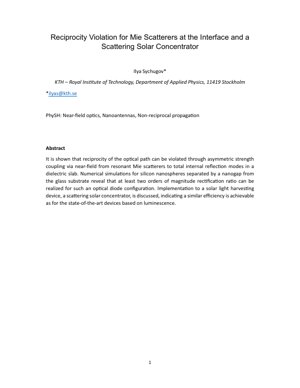
This paper isn't just another incremental tweak on non-reciprocity; it's a clever, almost minimalist, hack of fundamental wave physics. The authors have identified a potent asymmetry hiding in plain sight: the mismatch between the exponential imprisonment of an evanescent TIR wave and the radiative generosity of a Mie resonance. By placing a resonant scatterer in the "no-man's-land" between these two regimes, they force a dramatic breakdown of reciprocity without invoking complex materials, magnetic fields, or nonlinearities—the usual heavy artillery. This is elegant physics with immediate engineering implications.
Logical Flow
The argument is compellingly simple: 1) Establish that true reciprocity violation is hard and valuable. 2) Position Mie resonators as ideal low-loss building blocks. 3) Introduce the interface geometry as the symmetry-breaking element. 4) Use the stark contrast in near-field decay laws ($e^{-x/x_{1/e}}$ vs. $~r^{-1}$) as the qualitative engine. 5) Back it with numerical proof (100:1 ratio). 6) Propose a high-impact application (solar concentrator) to transition from a physics curiosity to a potential device. The logic chain is robust and commercially savvy.
Strengths & Flaws
Strengths: Conceptual brilliance and simplicity. Leverages well-understood phenomena (TIR, Mie scattering) in a novel combination. The predicted performance (100:1) is significant for a passive, linear structure. The solar concentrator application is timely and addresses a real-world efficiency-loss problem (re-absorption in luminescent concentrators, as noted in Debije's review).
Flaws & Gaps: The analysis, while promising, feels preliminary. Where is the experimental validation? Fabricating and characterizing a controlled nanogap with a single NP is non-trivial. The paper is silent on bandwidth—the 100:1 ratio is likely at a single resonance peak. For solar applications, broadband performance is king. How does an array of NPs interact? Will cross-talk between scatterers degrade the effect? The comparison to state-of-the-art luminescent concentrator efficiency is speculative without full-system optical and electrical modeling.
Actionable Insights
For researchers: This is a fertile ground. Priority #1 is experimental demonstration. Priority #2 is broadband optimization using multi-resonant or aperiodic NP arrays, perhaps drawing inspiration from machine-learning-aided photonic design, similar to trends seen in metasurface research. Explore 2D material heterostructures for ultimate thinness.
For industry (PV, Photonics): Watch this space closely. If the broadband challenge can be solved, this technology could disrupt the planar concentrator market. It promises a potentially more stable and scalable alternative to organic dyes or quantum dots. For integrated photonics, the quest for a compact, CMOS-compatible optical isolator is the holy grail; this approach deserves R&D funding to explore its limits in an on-chip configuration. Start prototyping small-scale devices to test manufacturability and real-world angular/spectral acceptance.
Bottom Line: This work is a potent seed. It may not be the final answer, but it points decisively to a new and promising path for controlling light's directionality. The onus is now on the community to cultivate it into a viable technology.