1. Introduction
This paper elucidates the current scenario of conventional solar power usage and explores potential methods to enhance its efficiency through nanotechnology. The sun's energy release is estimated to be about 10,000 times greater than the energy that could be extracted from conventional fossil fuels. However, current solar energy conversion for domestic and industrial purposes remains relatively low, with only about 10–25% of incident solar energy being captured for electricity production.
Solar Energy Potential
Sun's energy output: ~10,000x fossil fuel potential
Current capture efficiency: 10–25%
Energy loss in conventional cells: ~70%
2. Solar Power
2.1 Conventional Photovoltaic Cells
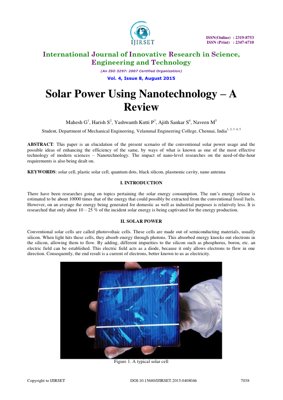
Conventional solar cells, known as photovoltaic cells, are made from semiconducting materials, typically silicon. When light strikes these cells, photons transfer energy to electrons in the silicon, knocking them loose and allowing them to flow. By adding impurities like phosphorus and boron, an electric field is established that acts as a diode, permitting electron flow in only one direction, thus generating electricity.
Figure 1: Typical Solar Cell Operation
The diagram illustrates photon absorption, electron excitation, and current generation through the p-n junction in a silicon solar cell.
2.2 Limitations of Conventional Solar Cells
Two primary limitations hinder widespread adoption:
- Low Efficiency: In conventional silicon cells, photons must have optimal energy to excite electrons. Lower-energy photons pass through without interaction, while higher-energy photons lose excess energy as heat, resulting in approximately 70% energy losses.
- High Cost: Fabrication costs are substantial, making solar cells unaffordable for rural and remote applications where grid extension is impractical.
3. Plastic Solar Cells
Nanotechnology offers promising solutions for reducing manufacturing costs and enhancing solar panel efficiency. Researchers at the University of California, Berkeley, have developed cheap plastic solar cells that can be applied like paint to various surfaces. These organic photovoltaic cells use conductive polymers and nano-structured materials to convert sunlight into electricity.
Key Insights
- Nanotechnology enables cost reduction through scalable manufacturing processes
- Plastic solar cells offer flexibility and application versatility
- Nano-structured materials enhance light absorption and charge separation
4. Key Nanotechnology Approaches
4.1 Quantum Dots
Quantum dots are semiconductor nanoparticles that exhibit quantum mechanical properties. Their bandgap can be tuned by changing their size, allowing absorption of specific wavelengths of light. This enables multi-exciton generation, potentially exceeding the Shockley-Queisser limit of ~33% for single-junction solar cells.
4.2 Black Silicon
Black silicon is created by etching silicon surfaces with nanoscale structures that dramatically reduce light reflection. These nanostructures trap photons through multiple internal reflections, increasing light absorption across a broad spectrum, particularly in the infrared region.
4.3 Plasmonic Cavities
Plasmonic cavities use metal nanoparticles to concentrate light through surface plasmon resonance. When light interacts with these nanoparticles, it creates oscillating electrons that generate intense localized electromagnetic fields, enhancing light absorption in adjacent semiconductor materials.
4.4 Nano-Antennas
Nano-antennas are designed to capture specific wavelengths of light more efficiently than conventional solar cells. These metallic nanostructures can be tuned to resonate with particular frequencies, potentially capturing infrared radiation that conventional silicon cells cannot utilize effectively.
5. Technical Details & Mathematical Models
The efficiency of a solar cell is fundamentally governed by the Shockley-Queisser limit, which describes the maximum theoretical efficiency of a single-junction solar cell under standard test conditions:
$\eta_{max} = \frac{P_{max}}{P_{in}} = \frac{J_{sc} \times V_{oc} \times FF}{P_{in}}$
Where:
- $\eta_{max}$ = Maximum efficiency
- $P_{max}$ = Maximum power output
- $P_{in}$ = Incident solar power
- $J_{sc}$ = Short-circuit current density
- $V_{oc}$ = Open-circuit voltage
- $FF$ = Fill factor
For quantum dot solar cells, the multiple exciton generation (MEG) process can be described by:
$\eta_{MEG} = \frac{N_{ex}}{N_{ph}} \times \eta_{collection}$
Where $N_{ex}$ is the number of excitons generated per absorbed photon and $N_{ph}$ is the number of incident photons.
6. Experimental Results & Performance
Experimental studies have demonstrated significant improvements through nanotechnology:
- Plastic Solar Cells: Laboratory prototypes have achieved efficiencies of 10-12%, with potential for 15% in optimized structures (National Renewable Energy Laboratory data).
- Quantum Dot Cells: Research at Los Alamos National Laboratory has shown external quantum efficiencies exceeding 100% for specific wavelengths due to MEG effects.
- Black Silicon: Reflectivity reduced to less than 2% across visible spectrum, compared to 30-35% for polished silicon.
- Plasmonic Enhancement: Light absorption increased by 20-30% in thin-film solar cells incorporating silver nanoparticles.
Performance Comparison Chart
The chart would show efficiency improvements across different nanotechnology approaches compared to conventional silicon cells, highlighting quantum dot cells' potential to exceed theoretical limits through MEG.
7. Analysis Framework & Case Study
Industry Analyst Perspective
Core Insight
This paper correctly identifies nanotechnology as the critical enabler for overcoming the fundamental limitations of conventional photovoltaics, but it underestimates the commercialization challenges. The real breakthrough isn't just in efficiency gains—it's in the paradigm shift from rigid, expensive silicon wafers to flexible, printable, and potentially ubiquitous energy harvesting surfaces.
Logical Flow
The paper follows a conventional academic structure: problem statement (low efficiency, high cost) → proposed solution (nanotechnology) → specific approaches. However, it misses the crucial connection between material science advancements and manufacturing scalability. The transition from UC Berkeley's "paintable solar cells" to commercial products requires addressing stability, lifetime, and production yield issues that aren't sufficiently emphasized.
Strengths & Flaws
Strengths: Comprehensive coverage of key nanotechnology approaches; clear explanation of fundamental limitations; appropriate focus on cost reduction for developing nations like India.
Critical Flaws: Lacks quantitative economic analysis; omits discussion of stability and degradation (plastic solar cells typically degrade faster than silicon); doesn't address the toxicity concerns of some nanomaterials (e.g., cadmium in quantum dots); fails to reference competing approaches like perovskite solar cells that have achieved >25% efficiency in research settings.
Actionable Insights
1. Prioritize Plasmonics & Black Silicon for Near-Term Deployment: These approaches offer immediate efficiency boosts to existing silicon technology with relatively low integration complexity, as demonstrated by companies like Natcore Technology and Silevo.
2. Establish Material Safety Protocols: Before scaling quantum dot production, develop comprehensive lifecycle assessments and recycling systems, learning from the photovoltaic industry's handling of cadmium telluride.
3. Focus on Hybrid Approaches: The highest potential lies in combining multiple nanotechnology approaches—for instance, plasmonic nanoparticles on black silicon with quantum dot sensitization—as seen in cutting-edge research from MIT and Stanford.
4. Leverage AI/ML for Nanomaterial Design: Apply machine learning algorithms similar to those used in drug discovery to accelerate the development of optimal nanostructures, reducing the traditional trial-and-error approach in materials science.
Analysis Framework Example: Technology Readiness Level (TRL) Assessment
Using NASA's TRL scale (1-9), we can evaluate each nanotechnology approach:
- Plastic Solar Cells: TRL 5-6 (Technology demonstrated in relevant environment)
- Quantum Dot Solar Cells: TRL 4-5 (Technology validated in lab)
- Black Silicon: TRL 6-7 (System prototype demonstration in operational environment)
- Plasmonic Cavities: TRL 4-5 (Component validation in laboratory environment)
- Nano-Antennas: TRL 3-4 (Analytical and experimental proof of concept)
This framework helps prioritize research investment toward technologies closer to commercialization while maintaining strategic bets on longer-term breakthroughs.
8. Future Applications & Research Directions
The integration of nanotechnology in solar energy promises transformative applications:
- Building-Integrated Photovoltaics (BIPV): Transparent or colored solar windows using quantum dot luminescent solar concentrators
- Wearable Energy Harvesters: Flexible solar cells integrated into clothing, backpacks, and portable devices
- Internet of Things (IoT) Power: Nano-enabled solar cells providing perpetual power for distributed sensors and devices
- Space Applications: Ultra-lightweight, radiation-resistant solar arrays for satellites and space exploration
- Agrivoltaics: Semi-transparent solar panels allowing simultaneous energy generation and crop production
Critical research directions include:
- Developing lead-free and non-toxic quantum dot materials
- Improving stability and lifetime of organic photovoltaic materials
- Scaling up nanomanufacturing processes for cost-effective production
- Integrating energy storage directly into solar cell structures
- Exploring artificial photosynthesis approaches using nano-catalysts
9. References
- Mahesh G, Harish S, Yashwanth Kutti P, Ajith Sankar S, Naveen M. "Solar Power Using Nanotechnology – A Review." International Journal of Innovative Research in Science, Engineering and Technology. 2015;4(8):7038-7040.
- Shockley W, Queisser HJ. "Detailed Balance Limit of Efficiency of p-n Junction Solar Cells." Journal of Applied Physics. 1961;32(3):510-519.
- National Renewable Energy Laboratory (NREL). "Best Research-Cell Efficiency Chart." 2023. https://www.nrel.gov/pv/cell-efficiency.html
- Nozik AJ. "Multiple exciton generation in semiconductor quantum dots." Chemical Physics Letters. 2008;457(1-3):3-11.
- Atwater HA, Polman A. "Plasmonics for improved photovoltaic devices." Nature Materials. 2010;9(3):205-213.
- Sargent EH. "Infrared quantum dots." Advanced Materials. 2005;17(5):515-522.
- Zhu J, et al. "Black silicon: fabrication methods, properties and solar energy applications." Energy & Environmental Science. 2009;2(4):400-409.
- Service RF. "Solar energy. Can the upstarts top silicon?" Science. 2008;319(5864):718-720.
- International Energy Agency (IEA). "Trends in Photovoltaic Applications 2023." IEA PVPS Task 1.
- MIT Energy Initiative. "The Future of Solar Energy." 2015. https://energy.mit.edu/research/future-solar-energy/
Original Analysis: The Nanotechnology Revolution in Solar Energy
This 2015 review paper captures a pivotal moment in solar technology development—the transition from incremental improvements in silicon photovoltaics to fundamentally new approaches enabled by nanotechnology. While the paper correctly identifies the key limitations of conventional solar cells (the Shockley-Queisser limit and high manufacturing costs), it represents an optimistic snapshot of a field that has since evolved in unexpected directions.
The most significant development since this paper's publication has been the meteoric rise of perovskite solar cells, which achieved laboratory efficiencies from 3.8% in 2009 to over 25% today—a trajectory far steeper than any technology mentioned in this review. This highlights a critical limitation of the paper's scope: by focusing exclusively on nanotechnology approaches that modify or complement silicon, it misses disruptive alternatives that could leapfrog silicon entirely. The perovskite revolution demonstrates that sometimes the most transformative advances come from completely new material systems rather than nano-engineering existing ones.
Nevertheless, the paper's core thesis remains valid: nanotechnology enables unprecedented control over light-matter interactions at scales smaller than the wavelength of light. The plasmonic approaches discussed have proven particularly valuable for thin-film solar cells, where light trapping is essential. Research from Stanford University and the University of California, Berkeley has shown that properly designed metallic nanostructures can enhance light absorption by over 50% in sub-micron silicon layers. Similarly, black silicon technology has moved from laboratory curiosity to commercial application, with companies like Silevo (now part of SolarCity/Tesla) incorporating nanostructured surfaces into their production modules.
Where the paper shows its age is in its treatment of quantum dots. While the theoretical potential for multiple exciton generation remains compelling, practical implementations have struggled with stability, toxicity (particularly for cadmium-based dots), and inefficient charge extraction. More promising has been the use of quantum dots as spectral converters—changing high-energy photons to optimal energies for silicon absorption—an application not mentioned in the paper but now seeing commercial development.
The paper's emphasis on plastic solar cells reflects the optimism of the mid-2010s about organic photovoltaics (OPV). While OPV has found niche applications in building-integrated photovoltaics and consumer electronics, it has not achieved the cost-performance ratio needed to compete with silicon in utility-scale applications. The stability issues briefly mentioned have proven more challenging than anticipated, with most OPV materials degrading significantly faster than silicon under real-world conditions.
Looking forward, the most promising direction may be hybrid approaches that combine the best features of multiple technologies. For instance, perovskite-silicon tandem cells now exceed 30% efficiency in laboratory settings by using the complementary absorption spectra of both materials. Nanotechnology plays a crucial role in these tandems through interface engineering and light management structures. Similarly, quantum dot-sensitized solar cells represent another hybrid approach with potential for low-cost, high-efficiency devices.
From an industry perspective, the paper's focus on developing nations like India has proven prescient. India's National Solar Mission has made the country a global leader in solar deployment, with nanotechnology-enabled solutions playing an increasing role in meeting the dual challenges of cost and efficiency. The ability to manufacture solar cells using printing or coating processes—as suggested by the "paintable solar cells" mentioned—could be particularly transformative for distributed energy systems in regions without established grid infrastructure.
In conclusion, while this 2015 review captures important nanotechnology approaches, the field has evolved toward more integrated and hybrid solutions. The ultimate role of nanotechnology may not be in creating entirely new solar cell architectures but in enabling incremental improvements across multiple technologies—from silicon to perovskites to emerging materials—pushing the entire field toward higher efficiencies, lower costs, and new applications.