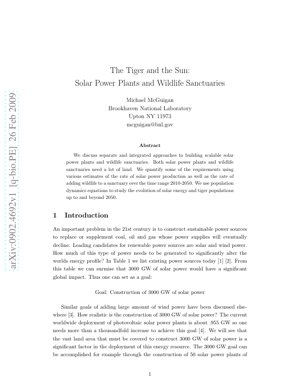
1. Introduction
This paper addresses two critical 21st-century challenges: the construction of sustainable power sources to replace declining fossil fuels, and the preservation of endangered species through wildlife sanctuaries. Both endeavors require vast land areas, presenting an opportunity for integrated planning.
The paper sets ambitious quantitative goals: constructing 3000 GW of solar power capacity and establishing a wildlife sanctuary supporting 3000 wild tigers. These goals represent approximately a thousandfold increase from 2009 deployment levels, highlighting the scale of the challenge.
Global Power Sources (2004)
Total World Capacity: 14,830 GW
Solar Goal: 3000 GW (Significant portion)
Wild Tiger Populations (2009)
Total Wild Tigers: ~3,536
Sanctuary Goal: +3000 tigers
2. Solar Power Deployment: Rates and Land Requirements
The paper analyzes the feasibility of deploying 3000 GW of solar power. Given the 2009 worldwide photovoltaic capacity of approximately 0.955 GW, achieving this goal requires massive scaling. The land area required is identified as a significant constraint.
Various deployment scenarios are considered: 50 plants of 60 GW each, 3000 plants of 1 GW, or 30,000 plants of 100 MW. The analysis in Section 4 focuses on a specific 60 GW plant case study to understand land use implications.
Key factors include solar irradiance, panel efficiency (which was lower in 2009 compared to today's standards), and the geographical distribution of suitable land that does not conflict with other critical uses like agriculture or dense human settlements.
3. Tiger Sanctuary Deployment: Rates and Land Requirements
Establishing a sanctuary for 3000 tigers is analyzed, focusing on the Bengal tiger subspecies as a primary example. The core requirement is land, with a single tiger requiring an average territory of 10 square miles.
The paper references a table detailing subspecies populations, required area, and prey populations. For instance, 1411 Bengal tigers require ~14,000 sq. miles and a prey base of ~700,000 animals. Scaling this, a 3000-tiger sanctuary would need approximately 30,000 sq. miles and a prey population around 1.5 million.
A significant challenge highlighted is reintroducing captive-bred tigers into the wild, requiring training in hunting and survival skills. The paper cites a project training five South China tigers as a proof-of-concept for scaling such efforts.
4. Integrated Approach for Solar Power and Wildlife Sanctuaries
The paper's central proposal is an integrated approach where solar power plants and wildlife sanctuaries are co-located or developed in a complementary manner. The rationale is that both require large, contiguous tracts of land that may be unsuitable for intensive agriculture or urban development.
Potential benefits include:
- Land Use Efficiency: Dual-purpose use of land for energy production and conservation.
- Reduced Conflict: Solar plants, especially photovoltaic (PV) farms, can have a lower direct physical impact on wildlife compared to urban or industrial development, potentially allowing certain species to inhabit the periphery or managed zones within the facility.
- Funding Synergy: Revenue from energy generation could potentially fund sanctuary management and anti-poaching efforts.
The paper suggests studying the specific case of a 60 GW solar plant to model its integration with a sanctuary.
5. Population Dynamics Modeling
The paper proposes using population dynamics equations to model the co-evolution of "solar energy capacity" and "tiger populations" from 2010 to 2050 and beyond. This formalizes the growth trajectories of both systems under various policy and investment scenarios.
The model would need to account for:
- Growth rates of solar deployment (in GW/year).
- Growth rates of tiger populations (in tigers/year), considering carrying capacity of the sanctuary.
- Potential coupling factors, such as how sanctuary management costs are supported by energy revenues, or how solar plant fencing and infrastructure affect tiger movement and prey availability.
6. Core Insight & Analyst's Perspective
Core Insight: McGuigan's 2009 paper is a prescient, though fundamentally speculative, thought experiment that identifies land as the critical shared constraint for two seemingly disparate global goals: renewable energy scale-up and megafauna conservation. Its genius lies in reframing this constraint not as a point of conflict, but as a potential point of synergy. The paper correctly anticipates the coming "land crunch" for renewables, a topic now central to reports from the International Renewable Energy Agency (IRENA) and the IPCC.
Logical Flow: The argument proceeds with elegant, back-of-the-envelope logic. It establishes audacious but quantifiable goals (3000 GW, 3000 tigers), breaks down the primary resource need for each (land area), and then asks the disruptive question: "What if we solved for both variables simultaneously?" The use of simple population dynamics equations, while not executed in detail, provides a credible quantitative framework to explore the interaction between the growth curves of energy infrastructure and animal populations over decades.
Strengths & Flaws: The paper's primary strength is its visionary, systems-thinking approach. It escapes the siloed mentality that plagues both energy and conservation planning. However, its flaws are significant from a 2024 perspective. It treats "solar power plants" monolithically, failing to distinguish between the vastly different ecological footprints of massive centralized CSP plants with steam turbines and distributed, low-profile photovoltaic (PV) arrays. Modern studies, like those from the National Renewable Energy Laboratory (NREL), show that PV facilities, with proper design (e.g., elevated panels, native vegetation underneath), can be compatible with certain forms of agriculture (agrivoltaics) and, by extension, some wildlife. The paper also glosses over profound ecological complexities. A tiger sanctuary isn't just land; it's a functioning ecosystem with specific prey densities, water sources, and connectivity corridors. The microclimate changes, fencing, and human activity associated with a 60 GW plant—imagine a facility covering hundreds of square miles—could easily fragment habitat and degrade its suitability for apex predators, regardless of funding. The model risks being economically naive, assuming linear benefits from co-location without accounting for the substantial added costs and engineering challenges of building wildlife-friendly infrastructure.
Actionable Insights: The paper's core concept remains valid but needs radical refinement. The integrated approach should be downgraded from co-locating massive plants with apex predator sanctuaries to a more nuanced strategy. The real opportunity lies in: 1) Strategic Siting: Prioritizing renewable projects on already degraded land (brownfields, abandoned farmland) identified by tools like the EPA's RE-Powering America's Land initiative, thereby avoiding intact wildlife habitat. 2) Technology-Specific Design: Promoting PV designs that emulate the principles of "agrivoltaics" for conservation—creating "conservoltaics" where panel arrays are optimized for grassland birds, pollinators, or other compatible species, not tigers. 3) Mitigation Banking 2.0: Leveraging renewable project revenues to fund high-integrity, off-site conservation and corridor projects as a mandatory part of development, creating a net-positive ecological impact. The future isn't a tiger sunbathing under a solar panel; it's a renewable energy sector that, through careful planning, advanced GIS modeling, and ecological engineering, achieves a net gain for biodiversity by systematically avoiding harm and financing restoration elsewhere.
7. Technical Details & Mathematical Framework
The paper proposes using coupled differential equations to model the system. A simplified version of such a model can be represented as:
Solar Capacity (S) Growth:
$\frac{dS}{dt} = r_S S \left(1 - \frac{S}{K_S}\right) + \alpha_{ST} T$
Tiger Population (T) Growth:
$\frac{dT}{dt} = r_T T \left(1 - \frac{T}{K_T(L)}\right) + \alpha_{TS} S$
Where:
- $S(t)$: Total solar power capacity (GW) at time $t$.
- $T(t)$: Tiger population in the sanctuary at time $t$.
- $r_S, r_T$: Intrinsic growth rates for solar deployment and tiger population.
- $K_S$: Carrying capacity for solar infrastructure, limited by economic, material, or policy factors.
- $K_T(L)$: Carrying capacity for tigers, a function of available and suitable land area $L$. $K_T(L) = \rho \cdot L$, where $\rho$ is tigers per unit area (e.g., 0.1 tigers/sq. mile).
- $\alpha_{ST}, \alpha_{TS}$: Coupling coefficients. $\alpha_{ST}$ could represent the positive effect of sanctuary-related funding or policy support on solar growth. $\alpha_{TS}$ could represent the positive effect of energy revenue on sanctuary management and anti-poaching, enhancing tiger survival/growth.
The land area $L$ is the key shared resource: $L = L_S + L_T + L_{shared}$, where $L_S$ is land exclusively for solar, $L_T$ is exclusive sanctuary land, and $L_{shared}$ is land used for both (e.g., buffer zones with low-impact solar).
8. Analysis Framework & Case Example
Scenario Analysis Framework: Since the PDF does not contain code, we outline a structured, non-code framework for evaluating integrated project proposals.
Case Example: Evaluating a "Solar-Sanctuary" Proposal in a Semi-Arid Region
- Goal Definition & Scaling:
- Solar Target: 1 GW capacity.
- Conservation Target: Create/restore habitat for a key species (e.g., Pronghorn antelope, a grassland herbivore), aiming to increase population by 500 individuals.
- Land Assessment:
- Exclusive-Use Zoning: Map areas for pure solar arrays (requiring minimal vegetation) and core wildlife zones (no infrastructure).
- Integrated-Use Zoning: Identify "conservoltaic" zones: areas under elevated solar panels where native grasses are planted and managed for herbivore forage.
- Connectivity: Ensure wildlife corridors link the core habitat zones, potentially going under fenced solar areas via wildlife passes.
- Quantitative Modeling Inputs:
- Solar: Land yield = 5 MW/acre (modern PV efficiency). For 1 GW, needs ~200 acres exclusive land + 300 acres integrated land.
- Wildlife: Pronghorn density = 2 animals/sq. mile in good habitat. To support +500 animals, needs ~250 sq. miles (~160,000 acres) of functional habitat.
- Synergy Factor: Does the integrated zone (300 acres of conservoltaics) provide better forage (shade, water retention) than degraded open land, thereby increasing effective habitat quality? This modifies the $K_T(L)$ function.
- Financial & Ecological Flow Model: Diagram the flows:
- Capital In: Investment for solar plant + premium for wildlife-friendly design (elevated racks, specialized fencing).
- Revenue Stream: Electricity sales.
- Cost Streams: Plant O&M + Sanctuary management (monitoring, patrols, habitat restoration).
- Ecological Output: Increased megawatt-hours and increased animal population/ biodiversity metrics.
- Evaluation: Compare this integrated project against two baselines: a) a standard solar plant on the same total land, and b) a standalone sanctuary of the same cost. Does the integrated project deliver a superior sum of energy and conservation outcomes?
9. Future Applications & Research Directions
The conceptual framework of the paper opens several modern research and application avenues:
- Conservoltaics: Active research area focusing on co-locating solar PV with biodiversity enhancements. Studies are needed on optimal panel height, spacing, and understory management for different species groups (pollinators, birds, small mammals).
- Advanced Siting Algorithms: Using GIS and machine learning to identify optimal locations for renewables that minimize biodiversity loss and, where possible, enhance conservation value, using datasets like the IUCN Red List and WWF's ecoregion maps.
- Dynamic Mitigation Banking: Developing markets where renewable energy developers can purchase "biodiversity credits" by financing certified conservation projects elsewhere, creating a scalable funding mechanism for sanctuaries.
- Technology-Specific Ecology: Comparative ecological impact studies of different renewable technologies (offshore wind vs. rooftop PV vs. desert CSP) on different taxa, moving beyond generic "land use" metrics.
- Policy Integration: Designing national and regional land-use policies that mandate or incentivize the kind of integrated planning this paper envisions, moving it from academic concept to planning requirement.
10. References
- McGuigan, M. (2009). The Tiger and the Sun: Solar Power Plants and Wildlife Sanctuaries. arXiv:0902.4692v1 [q-bio.PE].
- International Energy Agency (IEA). (2004). World Energy Outlook. (Source for Table 1 data in original PDF).
- International Renewable Energy Agency (IRENA). (2022). Renewable Power Generation Costs in 2021. Highlights the dramatic reduction in solar PV costs and increased efficiency since 2009.
- National Renewable Energy Laboratory (NREL). (2023). Land Use by Electricity Generation Technology. Provides current data on land-use requirements for various energy sources.
- Hernandez, R. R., et al. (2014). Environmental impacts of utility-scale solar energy. Renewable and Sustainable Energy Reviews, 29, 766-779. A key review on the ecological effects of large solar facilities.
- IPCC. (2022). Climate Change 2022: Mitigation of Climate Change. Working Group III Report. Discusses land-use challenges in large-scale renewable deployment.
- WWF. (2022). Living Planet Report 2022. Provides context on global biodiversity loss and conservation needs.
- U.S. Environmental Protection Agency (EPA). RE-Powering America's Land Initiative. [Website]. Provides tools and case studies for siting renewables on contaminated land.
- Isola, P., Zhu, J., Zhou, T., & Efros, A. A. (2017). Image-to-Image Translation with Conditional Adversarial Networks. (CycleGAN). Cited as an example of a transformative framework (like the integrated land-use framework proposed) that enables new modes of analysis and synthesis across different domains.